









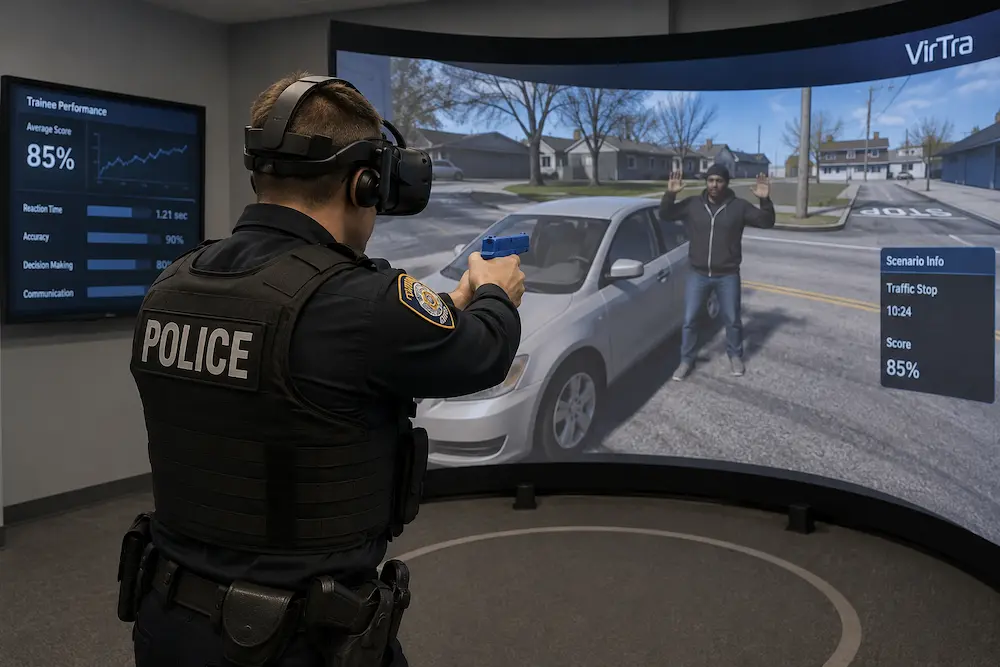
Police officers face situations that can change within seconds. A routine traffic stop can escalate unexpectedly, a domestic disturbance may involve hidden dangers, and an active threat requires rapid assessment under immense pressure. Preparing officers for these realities has always been one of the greatest challenges for law enforcement agencies. Traditional classroom instruction provides essential theoretical knowledge, while practical exercises develop physical skills, but neither can safely recreate the unpredictability of real-world encounters on demand.
This is one of the reasons why the law enforcement VR training simulator has become an increasingly valuable part of modern police training. By placing officers into immersive, interactive scenarios, virtual reality allows them to practise decision-making, communication and tactical responses in a controlled environment where mistakes become learning opportunities rather than real-world consequences.
Table of Contents
Training Beyond the Classroom
Learning legislation, procedures and operational policies forms an important foundation for every officer. However, knowing what should happen and applying that knowledge during a fast-moving incident are two very different challenges.
Virtual reality helps bridge that gap by presenting realistic situations that require participants to analyse information, communicate effectively and make timely decisions. Instead of passively discussing hypothetical incidents, officers actively experience them from a first-person perspective.
Because each scenario unfolds in real time, trainees must continuously evaluate changing circumstances rather than simply recalling information from memory.
A Safer Way to Experience Difficult Situations
Some incidents occur too infrequently—or are too dangerous—to practise regularly using conventional methods.
Hostage situations, active attacker incidents, mental health crises and complex public interactions all present unique training challenges. Recreating these environments physically can require extensive planning, specialist facilities and significant expense, while still exposing participants to certain risks.
Virtual reality removes many of these limitations by allowing agencies to recreate demanding situations repeatedly without placing officers or role players in danger.
Scenarios can be paused, restarted or adjusted to focus on particular learning objectives, giving instructors far greater flexibility than traditional exercises often allow.
Decision-Making Under Pressure
One of the defining characteristics of policing is the need to make sound decisions in stressful conditions.
Officers often have only moments to interpret behaviour, assess threats and determine the most appropriate response. Stress can influence perception, communication and judgement, making realistic practice especially valuable.
A law enforcement VR training simulator introduces controlled levels of pressure while allowing instructors to observe how participants respond. Following each exercise, officers can review their actions, discuss alternative approaches and identify opportunities for improvement before facing similar situations in the field.
Communication Is Just as Important as Tactics
Many police encounters are successfully resolved without force.
Clear communication, active listening and effective de-escalation techniques often play a significant role in achieving positive outcomes. For this reason, modern virtual reality scenarios frequently place as much emphasis on conversation as they do on tactical decision-making.
Participants may interact with distressed individuals, uncooperative witnesses or emotionally charged family members, requiring them to adapt their communication style as situations evolve.
This balanced approach helps reinforce that successful policing depends upon both interpersonal skills and operational competence.
Adapting to Different Types of Incidents
No two policing situations unfold in exactly the same way.
Modern virtual reality platforms can present a wide variety of environments, including residential properties, public spaces, commercial premises, schools and roadside incidents. Variables within each scenario can also change unexpectedly, preventing participants from relying solely on memorised responses.
By exposing officers to numerous different circumstances throughout their training, agencies help develop adaptable thinking that transfers more effectively into real operational environments.
Immediate Feedback Supports Learning
One of the greatest strengths of virtual reality training is the opportunity for detailed review immediately after each exercise.
Rather than relying on memory alone, instructors can discuss specific decisions, examine communication techniques and evaluate tactical choices while events remain fresh in the participant’s mind.
Constructive feedback encourages continuous improvement and helps officers understand not only what happened during the scenario, but why particular decisions produced certain outcomes.
This reflective process often becomes one of the most valuable parts of the learning experience.
Consistency Across Training Programmes
Traditional scenario-based exercises may vary depending on available instructors, locations and role players.
Virtual reality provides a greater degree of consistency by allowing multiple officers to experience comparable situations under similar conditions. While instructors can modify scenarios when required, agencies also benefit from having standardised exercises that support more consistent assessment and development across different training groups.
This consistency makes it easier to evaluate progress over time while maintaining high training standards throughout an organisation.
Supporting Continuous Professional Development
Training does not end when an officer graduates from the police academy.
Procedures evolve, new challenges emerge and experienced officers continue developing throughout their careers. Virtual reality allows agencies to provide ongoing refresher training without the extensive planning often associated with large-scale practical exercises.
Officers can revisit complex scenarios, practise infrequently encountered incidents and refine existing skills as operational requirements change.
This flexibility supports a culture of continuous learning while making high-quality training more accessible throughout an officer’s career.
Preparing Officers for Tomorrow’s Challenges
Modern policing demands technical knowledge, sound judgement, effective communication and the ability to remain composed under pressure. Meeting these expectations requires training methods that reflect the complexity of real-world policing.
A law enforcement VR training simulator offers an immersive environment where officers can build confidence, improve decision-making and develop practical skills without exposing themselves or others to unnecessary risk. As technology continues to advance, virtual reality is likely to play an increasingly important role in helping law enforcement agencies prepare officers for the unpredictable situations they encounter every day, creating safer training environments and supporting better operational outcomes.